
After a thousand years after the collapse of the Samanid state, the Tajik people got opportunity to start building their own state. It was not easy, but people have been able to pass the hardships and overcome many obstacles to reach their cherished dream.
October 14, 1924 the second session of Russian Central Executive Committee affirmed a decree of the Central Executive Committee of the Turkestan Autonomous Soviet Socialist Republic about national delimitation. On the base of this decree was created Tajik Autonomous Soviet Socialist Republic as a part of the Uzbek SSR.
Later, in accordance with the Decree of the Revolutionary Committee of the Uzbek republic from November 26, 1924 was created the Provisional Government of Tajikistan, which in fact was Revolutionary Committee.
In December 7, 1924 at the meeting of the Revolutionary Committee of the Tajik Autonomous Republic was considered the issue about organization of the People's Commissariat of Justice, the State Prosecutor's Office, as well as the people's courts and prosecution authorities. There was made a number of relevant decisions. One of them is the Decree from December 14, 1924 about organization of the People's Commissariat of Justice and the State Prosecutor's Office. Republican Prosecutor's Office became an independent department under the People's Commissariat of the Autonomous Republic.
People's Commissariat of Justice and the Prosecutor's Office started to work in December 22, 1924. From this day the prosecutor's office of the Republic of Tajikistan started their formation and development.
Tojiddin Saifuddin was appointed as Chairman of the People's Commissariat of Justice. Also he was the first approved to the post of prosecutor of the Tajik Autonomous Soviet Socialist Republic in February 18, 1925 until 1927. With the Decree of the Bureau of the Central Committee CP (B) of the Tajik Soviet Socialist Republic to the post of the prosecutor of the republic in 1927 was approved Mullozhon Sadullaev.
From December 5, 1929 the Tajik Republic has moved to a new stage of its historical development as a part of the former Soviet Union: Tajikistan gained national independence. From 1931 to 1935 Prosecutors of the Republic were Hodzhiyorov S., Imomov Ch., Rosenberg A. and Lebedev A..
Due to liquidation of the districts, district prosecutor's office were eliminated, instead of them have been created regional, city and district prosecutors, and prosecutors of Badakhshan Autonomous Region.
In a large cities and areas, which have great economic and political importance, under the districts prosecutors have been appointed one or more assistants of prosecutors, which amount was determined by the staff depending on the actual need.
District prosecutors were appointed and moved by the regional prosecutor. Regional prosecutors have got all the functions of the abolished district prosecutor's offices. Investigators were appointed by the district executive committees or the city council with the recommendations of the regional prosecutor's offices.
In 1930 by the Decree of Central Executive Committee and the CPC of the Tajik SSR was adopted Regulation "About the judicial authorities of the Tajik SSR."
Investigators were carrying out the investigation, management and supervision of the activities of other organs of the investigation and appear in the court as accuser (prosecutor).
The Prosecutor's Office of the Republic had strict supervision over the implementation of decrees of the Party and the government, took measures to curb any deviations from the requirements of the legislation which weakens or undermines economy. Prosecutors actively fought against profiteering, abuse, mismanagement, as well as the violation of the rights and legitimate interests of citizens.
On the base of the Decree of the CEC and Council of People’s Commissariats (CPC) from June 20, 1933 the prosecutor's office was separated from the People's Commissariat of Justice (PCJ) to an independent body. The USSR Prosecutor's Office was responsible for the overall management of the prosecutor's offices of the Union Republics, but a few years prosecutors of the Union republics at the same time were subordinated to the Prosecutor of the USSR and the PCJ. This made difficult the organization of the selection, placement and training of prosecutor-investigative personnel. By the Decree of the Central Executive Committee and Council of People’s Commissariats from June 20, 1936 "About the formation of the People's Commissariat of Justice of the USSR," the prosecutors of the Union republics were finally separated from the PCJ and completely subordinated to the prosecutor of the USSR. Since that time, the prosecutor's office became highly centralized. In 1946, the Supreme Council of the USSR awarded the prosecutor of the USSR name of the General Prosecutor of the USSR.
The prosecutor's office of Tajik SSR by 1964 were consist of: one urban and five regional prosecutor's offices in Badakhshan region; 9 city prosecutor's offices of republican subordination; 23 district prosecutor's offices; 4 prosecutor’s offices of military unit - a total of 42 prosecutor’s offices. In 1964 the Republican prosecutor's office had 8 departments.
The period of the Republican prosecutor's office formation and its further development are associated with the names of such prominent personalities of this field, as S. Ismoilzoda, A. Rakhmonov, Imomov Ch., M. Sadullaev, Sayfiddinov T., S. Hodzhiyorov, N.V. Zhogin, V.A. Bulargin and others who took the difficult task of building the foundations of the prosecutor's office in Tajikistan.
During this period and later the post of the Prosecutor of the Republic were held by: 1935-1938 – I.V. Ilyin, 1938-1948 - A.Ya. Romanov, 1948-1958 - N.V. Zhogin, 1958-1961 - H.H. Huseynov, 1961-1973 -V.A. Bulargin, 1973-1981 - A.A. Schelochinin, 1981-1986 - Yu.N.Scherbakov, 1986-1990 - G.S.Mihaylin and 1991-1992 - N.H.Huvaydullaev.
In January 1966, was established a professional honorary rank "Honored Lawyer of the Tajik SSR." This rank was awarded to lawyers for their merit in strengthening the legality and achieving the higher index in the investigation. From 1967 to 1990 35 prosecutors were awarded by this honorary rank.
In 1991 Tajikistan declared its sovereignty and independence. The young state, at the behest of history, due to the collapse of the Soviet Union - moved to a new stage of its development, appeared new conditions for the improvement of the activity of the prosecution.
The events of 1990-1994 were a serious test of the viability of the Tajik Prosecutor's Office.
In these fateful years N. Huvaydullaev (1991-1992 years) became the first General Prosecutor of independent Tajikistan.
The historical 16 session of the Supreme Council of the Republic of Tajikistan which was convened in November 1992 by the request of the People's Front and the population of the republic, restored constitutional government and M.S. Salihov was appointed to the post of the General Prosecutor of the Republic.
After the restoration of constitutional government in the country a brigade has started to investigate and solve crimes. The brigade was consisted of 35 groups from 250 skilled operative investigative prosecutors, CNS and the Ministry of Interior.
For the first time in the history of the prosecution of the republic in 1992 was adopted the Law "About Prosecutor's Office of the Republic of Tajikistan" and in accordance with the decree of the Supreme Council from April 30, 1992 entered into force.
According to this law, the functions of the prosecutor’s office were providing the supremacy of law, strengthening the legality in order to protect: the independence and sovereign rights of the Republic of Tajikistan; socio-economic, political and other rights and freedoms of citizens; the foundations of the democratic structure of the government, the legal status of local councils of people's deputies, state bodies and public organizations.
The prosecutor's office in Tajikistan, along with legislative, executive, administrative and judicial bodies carried out an independent form of government activity and its main directions were:
- Supervision of the law compliance by public authorities, enterprises, institutions, organizations, officials and citizens (general supervision);
- Supervision of the law compliance by bodies engaged in the fight against crime and other offenses, as well as the bodies of inquiry and preliminary investigation;
- Supervision of the law compliance during considering civil cases, criminal cases, cases of administrative offenses in the courts, commercial disputes in arbitration courts and in making decisions, verdicts, resolution and rulings;
- Supervision of the execution of the laws in places of detention, pre-trial detention, during the enforcement of sentences and other coercive measures, sentenced by the court;
- Supervision of the law compliance in the bodies of military administration, military units and institutions;
- The investigation of crimes.
The Prosecutor's Office also participated in the development of measures to prevent the crimes and offenses, in the activity to improve and clarify the law.
Due to the development of society, in order to strengthen the legality, law enforcement and the fight against crime in March 11, 1996, and also in a new edition in July 25, 2005, was adopted Constitutional Law "About the Prosecutor's Office of the Republic of Tajikistan".
Currently, according to these constitutional laws to the main areas of activity of the prosecution were added the following:
-development of measures to prevent crimes, fight against corruption, terrorism, extremism and other violations of law together with other government agencies, participation in the work to improve and clarify the law;
-co-ordination of law enforcement agencies actions against crime and its prevention, corruption and other offenses;
- Participation in the consideration of the cases by the courts;
- Protesting against the decision, verdict, ruling of the courts which are contrary to the law.
The prosecutor's office in accordance with the legislation of the Republic of Tajikistan within its authority may act in other areas where the public prosecutor's supervision is necessary.
The prosecuting authorities due to their action are separate and carried them directly and on behalf of the state. In order to implement provisions of the law into practice by prosecutors requires high professionalism, qualification of knowledge, personal courage and a sense of justice.
In front of prosecutors has set task to direct their efforts to ensure the legality in all spheres of state and public life. This primarily refers to the high role of the prosecution in dealing with the important issues of the national economy.
Currently, the country has three regional prosecutor's office, 77 city and district prosecutors' offices. Main Military Prosecutor's Office of Tajikistan and five military prosecutor's offices, transport prosecutor's office of Tajikistan and its subsidiaries in the Soghd and Khatlon regions, three prosecutors to oversee the implementation of laws in prisons.
To improve the working conditions of prosecutors in these years new buildings have been built for prosecutor's offices.
Prosecutors always support policy of State and Government, and in the further will continue to perform their duties timely and in a high-level.
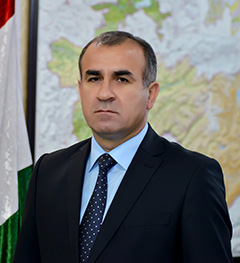
General Prosecutor's Office of the Republic of Tajikistan from 1992 to 1995 was headed by Salikhov Mahmadnazar Sohibovich, from 1995-1996 by Asimov Amirkul Nasimovich, from 1996-2000 by Salomiddin Sharipov, from 2000 to 2010 by Bobokhonov Bobodzhon Karimovich and from 2010 to 2014 Salimzoda Sherkhon Odin. Since January 2015, the leadership of the prosecution has entrusted to Rakhmon Yusuf Ahmadzod.
In accordance with the Law of the Republic of Tajikistan "About Amendments to the Law of the Republic of Tajikistan "About public holidays ", each year in March 13 is celebrating the prosecutors’ day.